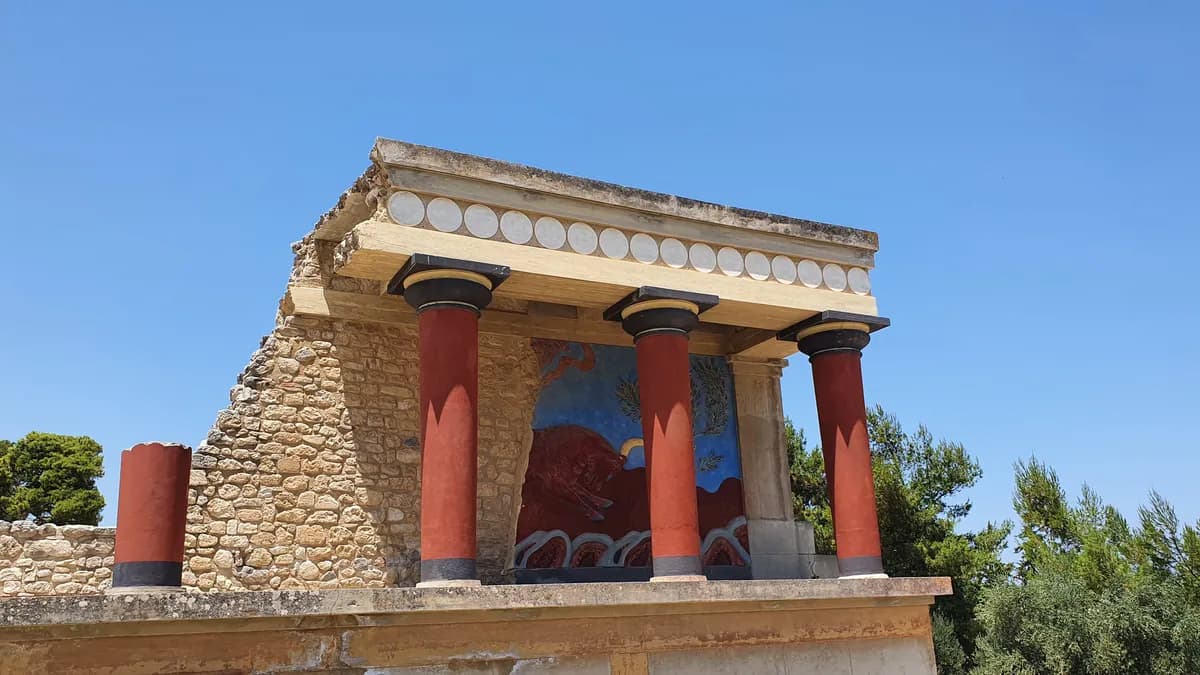
Knossos in summer is 38 degrees on white stone, with no shade. The red and ochre reconstructions give the site an immediately recognisable form — and a debated one. What remains is the scale of the rooms, the logic of the palace, and the sense that someone actually lived here.
What people underestimate
The site takes at least two hours done properly. Shade is rare, water essential. The Heraklion archaeological museum almost necessarily completes Knossos — many visitors do one without the other and miss half the picture. Advance tickets save around 20 minutes of queuing in July.
"Who is the Minotaur?" — Mia, 12, standing in front of the throne room frieze.
↓ Opening times, advance tickets and what we recommend seeing first if time is short.
Knossos is no mere ruin: it's a labyrinth of courtyards, staircases and frescoed halls, whose famous vividly painted reconstructions by Arthur Evans still divide purists. You can sense the complexity of a palace of more than 1,300 rooms, occupied from 2000 BC. The legend of the Minotaur and the labyrinth gains real depth here.
The visit is striking, but the site is very exposed to the sun and fills up fast. Coming at opening, or late in the day, transforms the experience. A guide (or a good audio guide) makes all the difference so you don't get lost in the layers of history.
My photos
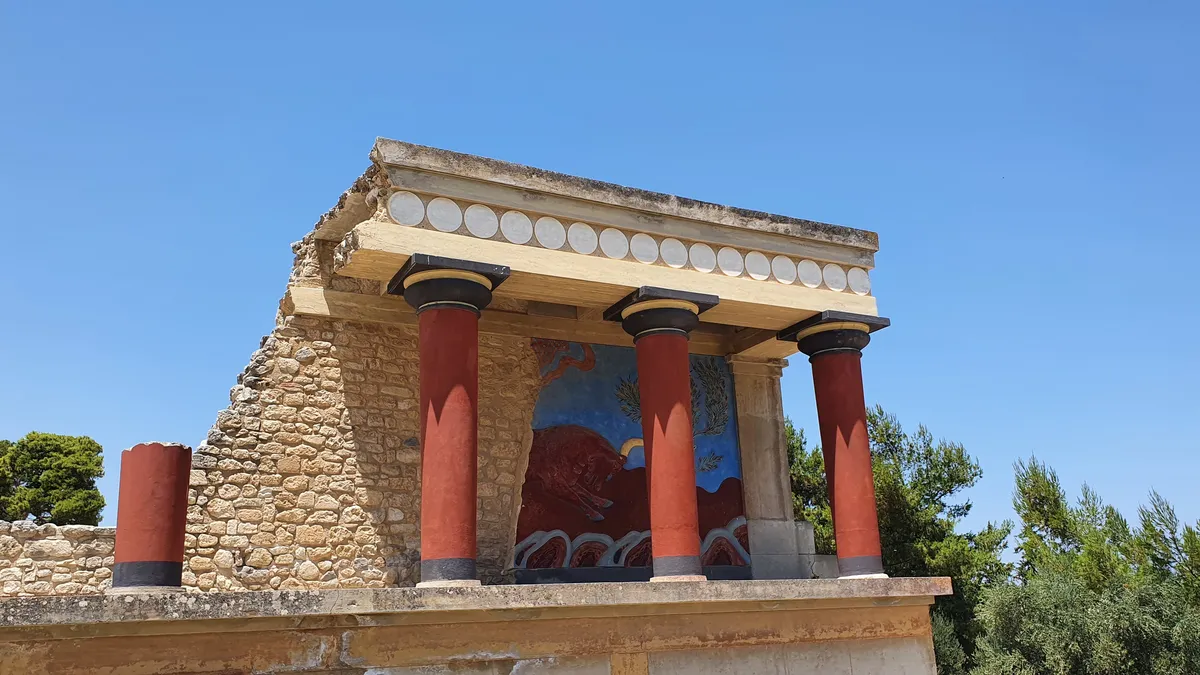
© Crète Immersion
What to know
- A major, unique archaeological site
- Spectacular frescoes and reconstructions
- Easy access from Heraklion
- Very busy in peak season
- Little shade, crushing summer heat
- Controversial reconstructions
Practical tip
Buy a combined ticket with the Heraklion Archaeological Museum, where the original frescoes are kept. Arrive at opening to avoid the crowds and the heat.
📍 Where is Palace of Knossos
Palace of Knossos caught your eye?
Build an itinerary that gives it a real place — with the spots that suit you.
Plan my trip →