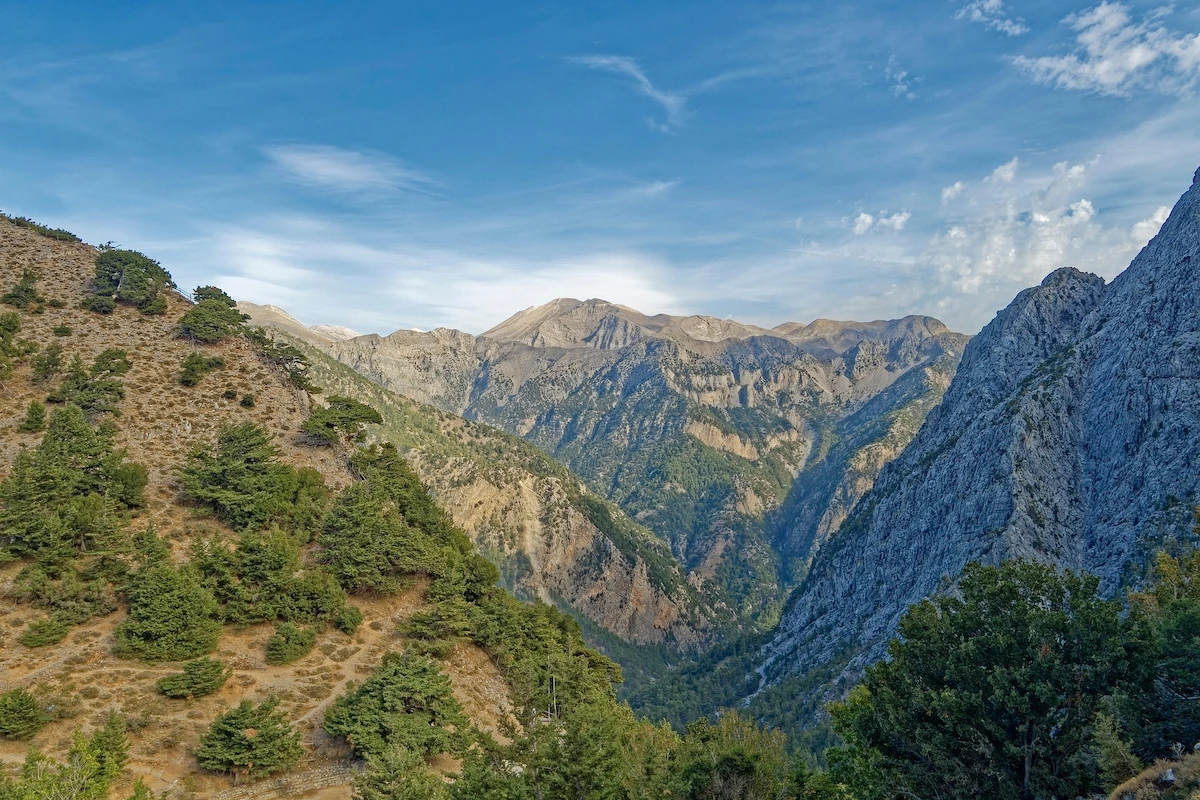
The finest gorges in Crete, beyond Samaria
Everyone does Samaria. Here are four verified gorges, one for each mood — the easy one, the waterfall, the thrilling one and the thousand-year forest — with the real figures and the logistics nobody explains.
Four gorges, four experiences
Agia Irini
Sougia · Chania (west)The “easy Samaria”, and the best place to start. Shaded, well-marked, no vertigo sections, open almost year-round. The descent (500 m against Samaria's 1,250 m) spares the knees; you exit at the Oasis taverna, then Sougia and its pebble beach.
Full details ↗Richtis
Exo Mouliana · Sitia (east)The waterfall nobody looks for. The green, damp heart of eastern Crete: old watermills, plane trees, a stream that runs even in summer — and a roughly 25 m fall that never dries up. The path ends on Richtis's wild pebble beach, in the shade of the tamarisks.
Full details ↗Aradena
Sfakia · Chania (south)The gorge for a thrill. You drop in from the vertiginous Aradena bridge (138 m, a bungee-jump platform) onto rocky ground, with a section of iron ladders bolted into the rock — bypassable by a path on the right if you dislike exposure. Exit at Marmara beach, then Loutro or Chora Sfakion via the E4 or by water taxi.
Full details ↗Rouvas
Zaros · Heraklion (centre)The thousand-year forest, far from the sea. Start at Lake Votomos (400 m) above Zaros, climb toward the Agios Nikolaos chapel and one of Crete's finest holm-oak forests — giant trees, some a thousand years old, on the flanks of Mount Psiloritis. Stony, demanding ground, but a shade and coolness found nowhere else on the island.
Full details ↗Samaria is magnificent. It's also packed, pricey and closed half the year.
16 km, 1,250 m of descent, tour buses from 7 a.m. and a May–October window only: Samaria earns its reputation, but it's neither the only gorge in Crete nor the smartest to walk. The island has dozens. The four below cover every profile — the family after an easy walk, the photographer chasing a waterfall, the thrill-seeker, and whoever wants forest shade far from the crowd. None of them makes you book a slot.
→ The complete Samaria Gorge guide (duration, access, easy version)
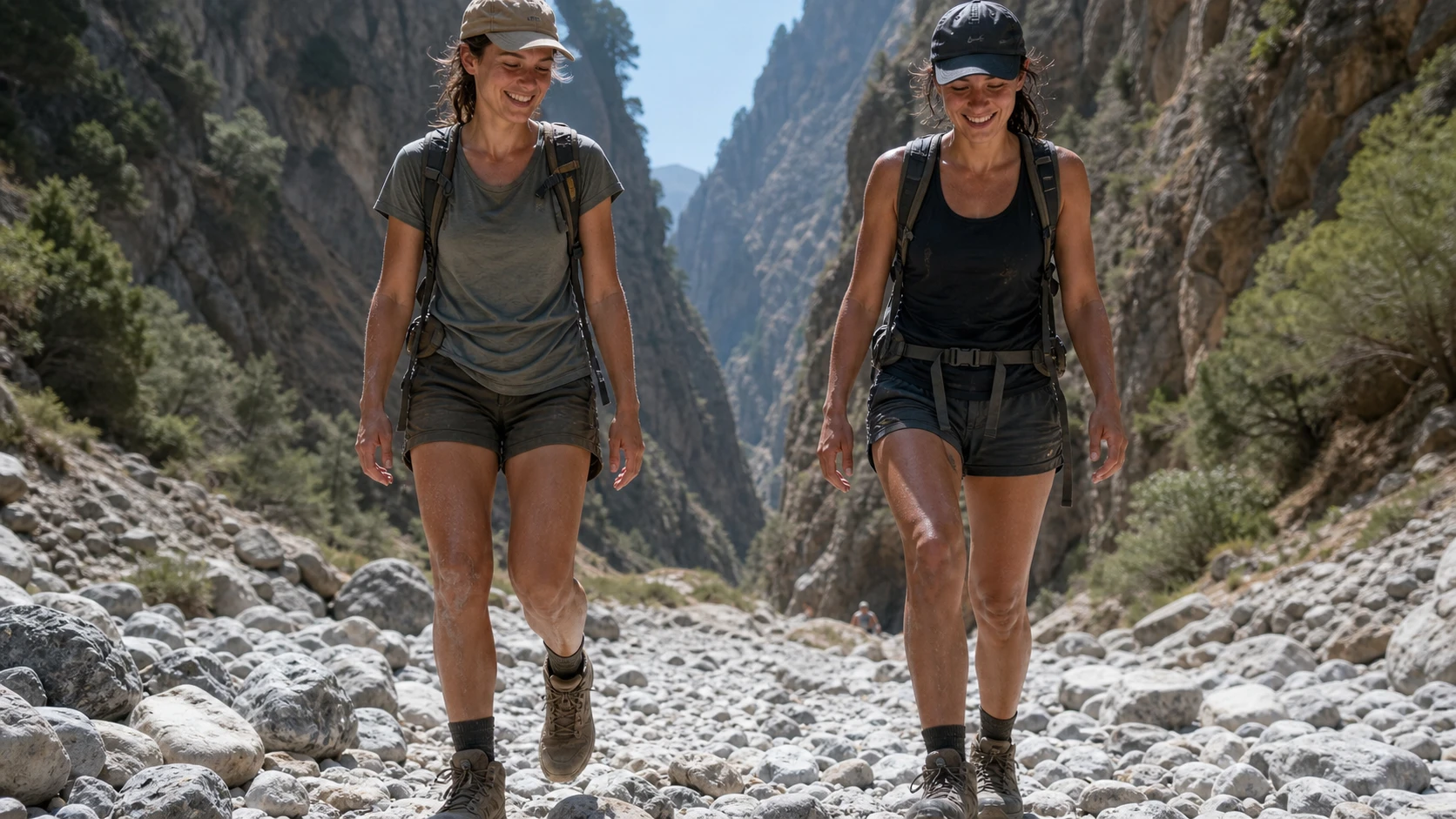
The real puzzle of a gorge is the return — not the walk
A gorge is walked downhill: you don't come out where you left the car. Three solutions, always the same. 1) Water taxi: in Sfakia (Aradena, Marmara exit), boats link Marmara/Loutro to Chora Sfakion. 2) KTEL bus: Agia Irini works beautifully from Chania, with a return bus from Sougia. 3) The loop: Rouvas comes back to its start — the only one that sidesteps the question. Golden rule: check the last boat or bus BEFORE you descend, never after. Carry 2 litres of water each, real closed shoes (the gorges are stony and slippery), and start early.
Frequently asked questions
What is the easiest gorge in Crete?
Agia Irini, near Sougia (west). 7.5 km of gentle, shaded descent, about 500 m of drop (against Samaria's 1,250 m), no vertigo sections, and suitable for children. It's open almost year-round, unlike Samaria (May–October).
Is there a real waterfall in Crete, even in summer?
Yes: the Richtis waterfall, in the Richtis gorge (eastern Crete, near Sitia). About 25 m high, it flows year-round thanks to the area's springs — one of the few on the island that doesn't dry up in summer. Most other Cretan “waterfalls” are seasonal (late winter and spring).
Do I need a car for these gorges?
Strongly recommended for Richtis and Rouvas, which are more remote. Agia Irini is served by KTEL buses from Chania (return from Sougia), and Aradena, in Sfakia, pairs with the south-coast water taxis. Since you walk a gorge downhill, always plan the return (boat, bus or loop) before you set off.
Is Aradena dangerous with its ladders?
The iron ladders bolted into the rock look daunting but are solid; more to the point, an alternative path on the right bypasses them entirely. Aradena's real challenge is the loose, rocky ground: good shoes and a sure step are enough. Avoid it in rain or flash-flood conditions.
String them into a real route
These gorges are scattered from west to east. Our generator threads them with the beaches, the villages and the right tempo, to your days and your level.
Build my itinerary →Plan
Getting around
Explore
Beaches
Best beaches›Voulisma (Golden Beach)›Secret beaches›Balos or Elafonissi?›Falasarna›Seitan Limania›Nature & adventure
Samaria Gorge›Gorges & waterfalls›Things to do›Excursions: worth it?›Activities & tours›Boat cruises›Santorini day trip›Culture & history
Knossos (tickets)›Spinalonga›Lato (Dorian city)›Gournia (Minoan town)›Battle of Crete›Authentic villages›Essentials