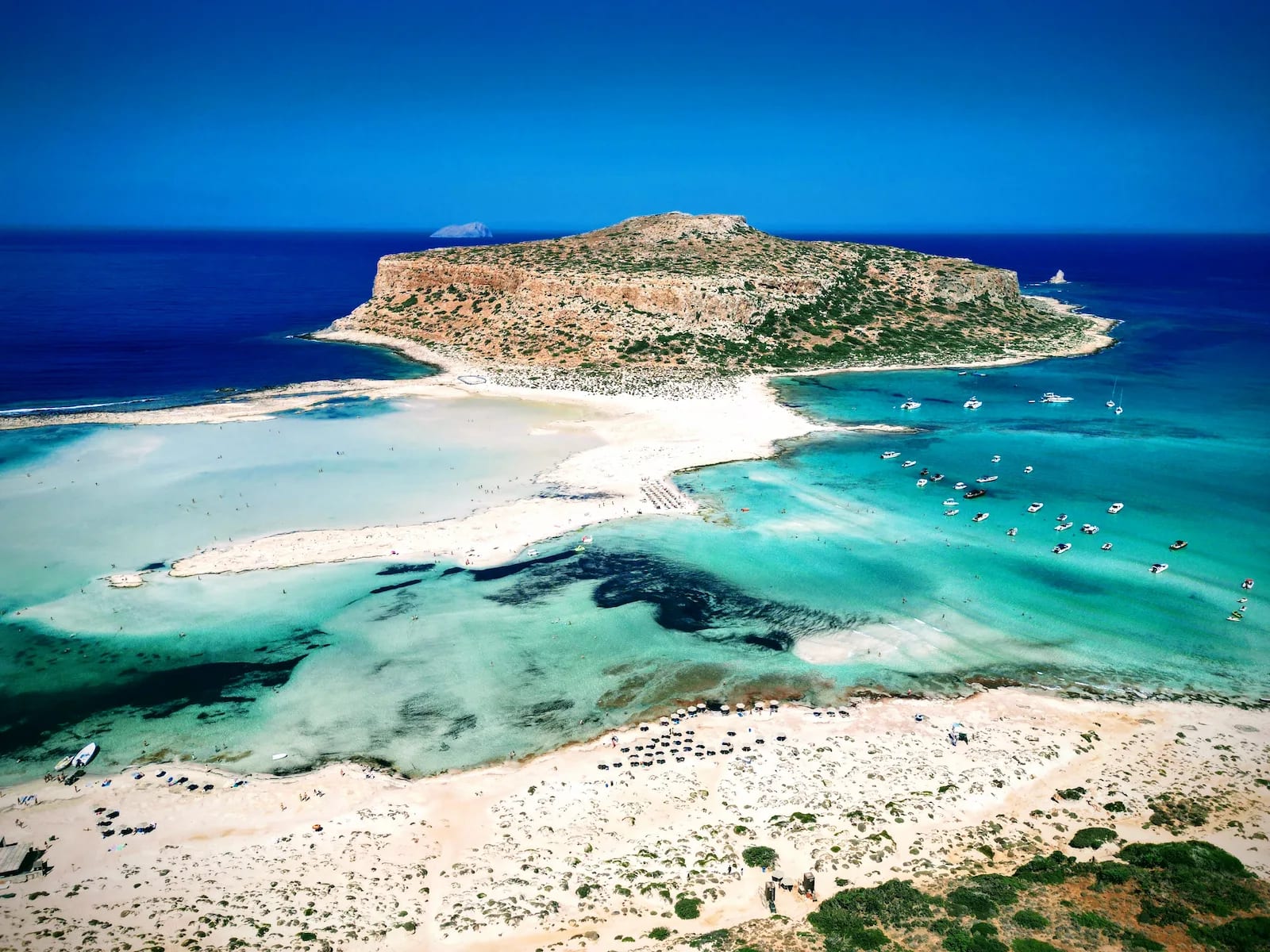
Crete in September
The water has never been warmer, the air stays summery, and families have gone home with the start of school. September delivers the best of Cretan summer with an added notch of calm.
In September, Crete keeps the warmest sea of the year (~26°C) and still-summery weather, while the August crowds recede once school restarts. But the real shift only comes around 10-15 September: the first half stays busy and pricey. The ideal window — warm sea, low prices, few people — runs 15 September to 10 October.
At a glance
The best compromise of the year: August warmth, off-season calm, sea at its peak.
The real shift: 10-15 September
This is the point almost no guide writes down: the first half of September is not the low season. Northern-European school holidays (Germany, the Netherlands, the UK) are still running, flights stay full, and hotels hold their August rates until around the 10th. The picture changes around the 10th-15th: accommodation prices drop 30-40%, car hire falls from ~€45 to ~€28 a day, and the famous beaches finally breathe. The sea, meanwhile, stays at its peak (~26°C) into early October. So the year's optimal window — warm sea, soft prices, thinned crowds — opens from 15 September to 10 October. If your calendar is free, aim for the second half rather than the first.
What closes, and on exactly what date
Most guides say “it closes in October” without a date. Here's what is genuinely calendar-driven — and what merely shortens its hours.
- 16 → 30 SeptemberArchaeological sites: 8am – 7pm. The summer schedule starts stepping down in fortnightly stages — Knossos, Phaistos, Spinalonga and the museums follow the same national grid.
- 1 → 15 OctoberArchaeological sites: 8am – 6:30pm. Still the golden window: nothing essential has closed, the sea is at 24°C and prices are off-season.
- ~15 OctoberSamaria Gorge: official closure, sometimes extended to the end of the month depending on weather and rockfalls. It's a moving date, never guaranteed — check the day's opening before driving out.
- 16 → 31 OctoberArchaeological sites: 8am – 6pm. The light goes early: a site visit started at 4pm gets short.
- 31 OctoberKourtaliotiko Gorge: last day of the ticketed season (it runs 1 May to 31 October, 9am – 7pm, €5/day — legal basis ΦΕΚ Β' 392). The same day, the fast EXPRESS Heraklion – Chania link runs its last service of the season.
- Late Sept → mid-OctoberDay boats: Balos and Gramvousa, Chrissi, Gavdos wind down gradually, operator by operator — there is no common date. On the south coast ANENDYK doesn't close but switches to a markedly reduced winter timetable: the Chora Sfakion – Loutro – Agia Roumeli links continue, less often.
Site hours follow the national fortnightly grid; each site may have its own exception (a weekly closing day, a late opening). Boat and taverna dates depend on the operator and the weather. Checked in August 2026.
The sea & the weather
It's the sea's thermal peak: around 26°C, a genuinely warm bath, after a whole summer of heat storage. The air stays firmly summery (27°C average, up to 29°C), skies clear, and rain almost absent. The meltemi, that northern summer wind, gradually eases. In a word: summer, gentler.
What's happening this month
It's harvest season: in the wineries of the Heraklion hinterland (Dafnes, Peza, Archanes), they press the grapes of Cretan varieties — Vidiano in white, Liatiko in red. Several estates open their doors for tastings. The beaches regain space, and the tavernas still run at full tilt without the crush.
Who it's for — and avoid if…
The ideal month for almost everyone: couples, families outside school holidays, beach and wine lovers. The only caveat: it's not yet total calm (visitor numbers around 60% of peak), and prices stay close to high season in the first half. Still book ahead for the best places.
What it costs
The budget turns with the crowds. A rental city car falls back to around €25-32 a day, against €40-65 at the height of August. Mid-range hotels come down to €100-120 a night in the second half — 30 to 40% less than mid-August. Flights stay dear the first week (school restart), then ease. Still book the car 1-2 months ahead: automatics, SUVs and 7-seaters go early, even off-peak.
August vs September: the numbers
Frequently asked questions
What's the sea temperature in Crete in September?
Around 26°C — the year's maximum: the sea has stored the whole summer's heat. Swimming is excellent everywhere, on both coasts, into early October.
August or September: which to choose?
The sea is almost identical (~26°C) and September is cooler, less windy and cheaper — but only from the 10th-15th. Before that, the first half stays busy (northern-European school holidays). For the best compromise, aim for the second half of September.
When does high season really end in Crete?
Not on 1 September, contrary to the cliché: the real shift is around 10-15 September, when northern-European school holidays end. Prices then drop 30-40% and the beaches empty, while the sea stays at 26°C.
Is September cheaper than August in Crete?
Clearly, but mainly in the second half: a rental city car falls to €25-32/day (vs €40-65 in August) and hotels shed 30-40%. The first half, though, stays close to August rates.
Is Crete still busy in September?
About 60% of peak visitor numbers, with a clear drop after the 10th-15th. September's international arrivals are roughly 18% below August's. The beaches breathe, the tavernas run, the atmosphere stays lively.
Can you do the Samaria Gorge in September?
Yes: Samaria stays open until around mid-October (weather permitting). September is kinder than high summer, but the lower gorge still heats up in the afternoon: start early, carry 2-3 L of water, and check the official opening the day before.
Are there jellyfish in Crete in September?
Possible in late summer (the mauve stinger blooms mainly August to October), but Crete isn't a hotspot like the Cyclades or Attica. If stung: get out, rinse with seawater (never fresh), remove the filaments, then apply heat ~45°C for 30 min. No vinegar, no ice.
Is it still warm enough to swim in late September?
Yes: the sea stays around 26°C into early October, warmer than in June. Days are mild to warm (24-30°C in the north). Only the evenings cool a little — bring a light layer for dinner.
Updated 16 August 2026 · Weather: 2016-2025 averages (Heraklion, Chania). Arrivals: INSETE 2025 data. Prices and availability indicative, checked August 2026 — they change, verify before booking.
Plan
Getting around
Explore
Beaches
Best beaches›Voulisma (Golden Beach)›Secret beaches›Balos or Elafonissi?›Falasarna›Seitan Limania›Nature & adventure
Samaria Gorge›Gorges & waterfalls›Things to do›Excursions: worth it?›Activities & tours›Boat cruises›Santorini day trip›Culture & history
Knossos (tickets)›Spinalonga›Lato (Dorian city)›Gournia (Minoan town)›Battle of Crete›Authentic villages›Essentials