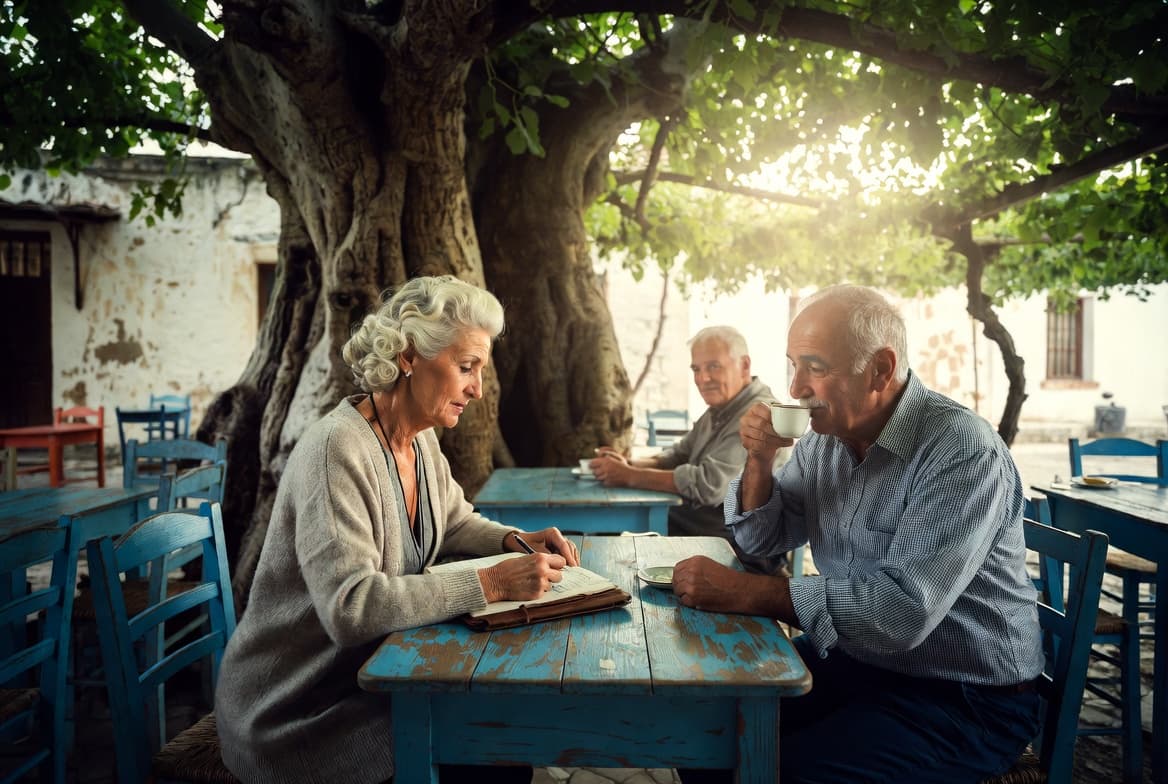
There are those who visit Crete at a sprint, collecting photos of famous beaches the way you tick boxes on a list. And then there's the ultimate luxury: having time.
This is the story of Bernard (68), a former engineer in love with old stones and silence, and Martine (65), whose sketchbook never leaves her side. To celebrate their retirement, they made a radical choice: to shun the summer high season and the "all-inclusive" hotels. Instead, they rented a little stone house for three weeks in May, in a village of the Apokoronas. Their goal was not to see the whole island, but to understand the Cretan soul.
This guide is a hymn to slowness. It's the story of endless Greek coffees under the plane trees, of chance encounters that last for hours, and of that sweetness of living that only the Mediterranean knows how to offer when you take the trouble to stop.
Week 1: the Kafenio ritual and the patina of time
The ambition ·Do nothing, but do it well. Blend into the rhythm of a traditional village.
On the ground: in the first few days, the "tourist" reflex lingers. Bernard wanted the car at 9:00 to visit Chania. But Crete, in spring, sets its own pace. In their village of Gavalochori, everything revolves around the central square.
Total immersion: on the third day, Bernard abandoned his watch. In the morning, the ritual fell into place. Walk down to buy fresh bread at the family bakery. Sit at the Kafenio (the village's traditional café) with the old men. At first, the looks were curious. Then Bernard ordered a Greek coffee "Sketo" (no sugar), and Martine began to draw the façade of the Orthodox church. The ice broke. The owner offered them a few olives from his garden. Without speaking the same language, to the dry clack of Tavli dice (the local backgammon) on the wooden tables, they were now part of the scenery.
The magic: one evening, on the way home, the neighbour, an old man with a face weathered by the sun, had left on their low wall a bag full of oranges from his orchard and a small pot of thyme honey. No note, just a thousand-year-old gesture of welcome, the famous Philoxenia (Cretan hospitality).
What if you stayed? Our guide to relocating to CreteWeek 2: the hidden monastery and the valley of olive trees
The ambition ·Explore the hinterland and Byzantine history while avoiding the queues.
On the ground: the Arkadi monastery is sublime, but often packed. On the advice of their village baker, Bernard traced a small winding road on his paper map (he hates GPS), heading for the Holy Trinity monastery (Agia Triada), on the Akrotiri peninsula.
Total immersion: the road snakes through olive groves several centuries old. Arriving at the monastery, the Venetian Renaissance architecture rises in a religious silence, broken only by birdsong. Unlike the timed excursions, they spent three hours there.
The magic: they crossed paths with a monk in the inner courtyard flowering with bougainvillea. Taking the time to strike up a conversation with a few words of English and smiles, he led them to the monastery's cellar. There, in the cool of the stone vaults, they tasted the organic olive oil and wine made on-site for generations. Martine left with a bottle, Bernard with the feeling of having touched eternity. This impromptu lunch in the shade of the cypresses, with bread, Graviera cheese and the monks' wine, remains their most memorable meal, far from the tourist-trap tavernas.
Extend towards Chania and the Akrotiri peninsulaWeek 3: the South coast and Maria's cooking lesson
The ambition ·End the stay with the sea air of the Libyan Sea, seeking the warmth of coastal villages spared by concrete.
On the ground: instead of the big resorts of the North, they crossed the majestic gorges by car, driving slowly to admire the goats clinging to the cliffs, to set their bags down in Sougia. It's a village of two streets, a beach of glittering grey pebbles and a few tavernas perched over the water.
Total immersion: Martine loves to cook. In the family taverna where they regularly ate lunch, she complimented the cook, Maria, on her dishes every day. The miracle of Cretan sociability struck again: on Thursday morning, Maria invited her into the kitchen.
The magic: while Bernard read a book facing the sea, lulled by the lapping of the waves, Martine learned to fold Kalitsounia (those little parcels of fresh cheese and mint) and to measure the cinnamon in Stifado (beef stew). There was flour everywhere, great bursts of laughter despite the language barrier, and an overflowing generosity. When they left Sougia a few days later, Maria came out of her kitchen to embrace them like old friends. They weren't only taking home memories of Crete — they had left a part of their heart there.
Buying a stone house in Crete: the investment guideFrequently asked questions
When is the best time for a slow stay in Crete?
May is ideal: mild temperatures, green and flowering nature, villages still authentic before the summer influx. It's the perfect season to settle into a village and take your time.
What is Cretan Philoxenia?
It's the traditional hospitality of Crete: a spontaneous, generous welcome to the stranger, expressed through small gestures — olives offered, oranges left at the door, an invitation into the kitchen — expecting nothing in return.
Can you visit a Cretan monastery away from the crowds?
Yes. Rather than Arkadi, often packed, the Agia Triada (Holy Trinity) monastery on the Akrotiri peninsula offers Venetian Renaissance architecture in calm, with olive oil and wine made on-site.
Where can you find an authentic coastal village on the south coast?
Sougia, reached after crossing the gorges, is a two-street village with a pebble beach and a few tavernas over the water — the opposite of the big concrete resorts of the North.